di Maria Turchetto (1998)
[ L'articolo è apparso sul n. 6-7 della rivista «Collegamenti Wobbly», new series, 1998-1999. See the same author, Fordism and Post-Fordism ]
Let me suggest some other comments critical of the current notion of "post-Fordism" is becoming a worrying "thought only of the left", inspired by Article Viscount of Grisi published in the previous issue of the magazine and suggesting some other reading "out of the choir" post-Fordist.
rightly concerned in, Grisi first put on guard against hasty generalizations of the phenomena of de-industrialization , decentralization of production and prevalence of small industry . On the one hand, according to the author, these phenomena are particularly pronounced in Italy, "are an expression of a particular relocation of this country within the international division of labor in ways certainly more peripheral, and therefore are in no way generalizable [1]. On the other hand, the features you would like the typical post-Fordist decentralization, "almost a kind of return on capital at the age of manufacture, or even craft [2], do not seem borne out by empirical data.
In fact, I myself feel that for real processes - That should be investigated further, however, in their actual size and incidence in different countries and different sectors - has engaged an interpretation strongly ideological , which then ends up meeting the ideology par excellence of our time, namely the defense of neo-liberal market, "thinking only of the right" but now attracts unsuspecting theorists of the left.
1. No doubt the "crisis" - or "restructuring" - began in the '70s has cracked some certainties, widely shared not only in Marxist area [3] about the trends of capitalist development: the tendency to increase in size of , which seems contradicted by the extensive process of decentralization, the renewed importance of small and medium enterprise., and the related trend towards monopolistic structure ( oligopolistic) market, which seems contradicted by the great return of competition, competition in a market consolidation, which today would recover its function as a rational mechanism and optimizing not only against state interference, but also against the distortions introduced by the giant companies.
Certainly it is no exaggeration in the first tackle questions related to the uniqueness of these trends (Perhaps based on a false evidence that what develops necessarily become "increasingly large") and then nell'enfatizzare exaggerating their reverse (what has fueled real legends, like those of "post" of "small is beautiful", a "perfect competition" which in the best traditions of thought neoclassical restore the sovereignty of the consumer ...).
To avoid errors of perspective and forth, I think it necessary - as I have repeatedly argued [4] - to overcome both the 'ideology of the stages "cumulative and irreversible, so the 'ideology of post- ", ie the radical transformation that would leave us with an unrecognizable to the point of capitalism is no longer capitalism but - for example, delusions of Negroes in the past - a free entrepreneurship mass" ideologies in the end affects comforting idea that the story works for us. Personally, I find it interesting some processing - very minority - which underline the recursion or cyclicality of certain tendencies. I think for example to Arrighi, who speaks of "stages of material expansion" and "stages of financial expansion [5], the latter typical times of crisis and restructuring of the system, or the fat, which speaks of "stages monocentric" and "polycentric phases [6], adopting a terminology for the truth that brings a little 'off the road indicating the geopolitical balance of capitalism more transformations that its "structural" - if I pass the word - which, in my opinion, are still looking into that world production of where, as Marx said, the writing stands No admittance except on business .
2. But about it just the fat, in some of his recent work [7] has put his finger on a point gentle enough: where production takes place? in the factory or in ' business? What is the difference between these two entities? And what are the boundaries of 'business than market? The Fat brought to this effect, a reinterpretation of the so-called theories of organization, namely, those theories that challenged the methodological individualism applied to the company as subjective decision-making unit rather complex organization [8]. Theories to explain the above born large company, but also say something about the phenomenon of decentralization production. The most valuable element of this heuristic in these theories seems to be the message of the mobility of the border that separates the 'inside' from 'outside' the company, and therefore in the indication that business and the market should not be regarded respectively as the subject and as an environment (external) in that such entity operates, but how different relational principles , connoting the report "marketable" as equal and uncertain and the constitutive relationship of the 'enterprise' as authoritarian and hierarchical, having as content the 'internalisation mercantile report [9 ].
Based on this concept, one can take the first step by saying that the market is perfectly competitive monopoly and market completely represent theoretical extremes, while the existing economic structures are actually a mixture of the two principles , unbalanced in one direction or another depending on the cost (respectively, transaction and organization ). A further step is to observe that the combination of the two principles is not distributed randomly in time and space, but seems to have a "recursion", alternating phases of prevailing principle of organization (and internalization) and therefore structure and a more monopolistic market Big Business (Steps calls "material expansion" by Arrighi), and phases in which prevale invece il principio di transazione (ed esternalizzazione) e dunque una struttura più concorrenziale e Small Business (le fasi di "espansione finanziaria").
Potremmo a questo punto fare un lungo elenco dei motivi che attualmente spingono in questa seconda direzione, e marcare l'accento sull'uno o sull'altro a seconda dei nostri "gusti" (delle nostre ipotesi interpretative guida). Chi tiene a presentare la crisi iniziata negli anni '70 come un risultato delle lotte operaie potrà sostenere che è difficile mantenere complesse strutture di controllo gerarchico e autoritario in presenza di forti livelli di conflittualità operaia, e che dunque il parziale smantellamento complex organizations respond to a defensive strategy of the capital. For my part, I tend to consider the capital accumulation as a kind of roller that goes on his way guided principally by the rate of profit, cyclically shifting resources from old to new areas. If this is true, the stage is a delicate moment of transition, characterized by two sets of processes. On the one hand, the ongoing restructuring involves divestments from mature sectors deterritorialization and large parts of these areas (which does not mean that these are smaterializzino and float in the air, as a part of the debate on "globalization" tends to believe, means that they are moving to different areas, redesigning a new international division of labor), which involves the dismantling of the old physical and organizational structure, which must be literally torn to pieces. " Second, the new investment , looking for areas that can give change to those obsolete in tow accumulation, they take themselves to their small size, which allow you to download and diversify risk, to "experiment "on a scale initially reduced new techniques and products, etc..
3. Beyond these considerations, the functionality of the decentralization process to shift to a new cycle accumulation (in this sense I disagree with the opinion that Viscount Grisi concludes the article said, arguing that the current phase "can be defined as the initial capitalist decadence" [10]), I would nevertheless like to stress that in this situation the ' emphasis now placed on the market not just a phenomenon of "ideological", but an effective organizing principle and - add - of discipline (in this sense, a phenomenon of "ideological" in the strong sense of the term and complex, not a story put about to attract the suckers, but something far more effective ).
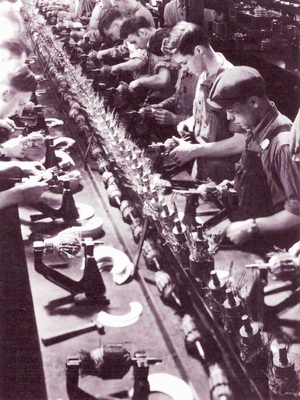
Take, for example, the Toyota built at Fiat's Melfi Italian [11]. On the one hand, there is the phenomenon of outsourcing a large part of production, "time out" on a number of small businesses for about 65% (with a reversal of the previous ratio, in which domestic production of components covered 65% and only 30-35% came from outside firms): In this sense, "more market" or market more Small Business . But the interesting thing is that the internal organization is inspired by the market model, giving some extent the principle of hierarchy, or - as rightly suspected Laura Bow - Concealment. In the "cellularisation manufacturing process [12] held in Ute (elementary technological units), each Ute is in fact designed as a lower case" enterprise ", supplier and customer uterus located downstream of that place before.
This produces, above all, an effect markedly ideological : for each "customer" stand, all for the end consumer, the new capricious ruler who refused the product of mass production has made it mandatory, flexible (Laura Bow Calling this ideological effect "effect kanban", stressing that this organization is not determined by consumer choice, but from the objective of manufacturing stocks to zero [13]). But it also produces a powerful effect of disciplining It is not the direction you FIATA directly on the neck, but the Ute expects the next piece: "workers who bring other workers to 'want' to work with the material" [14 ]. This discipline involves, of course, the external firms, stressed by just in time and driven by the appearance of an 'obligation of result "(the non plus ultra of freedom of contract) to step up pace and conditions of exploitation.
The governing principle in this delightfully mixed structure "Enterprise" and "market" is just in time (which then, as in fact, is more than a policy of rationalization of inventory and warehouse). As for the "market" and its principles, in this view it is far from the realm of freedom and democracy, and looks rather like another way to exercise control and discipline: as also Laura Bow, "the Fordism provided a control system at work through a hierarchical oppression, now recognized by all for what it was. ohnismo In contrast, the change (really) the way of exercising control [...]. The new organizational logic makes no only possible but also necessary both the partial reduction della struttura gerarchica dell'azienda sia un comportamento 'non piè militare' dei capi' (come dice uno dei responsabili del personale della Fiat). Ma ciò non significa che la direzione abbia rinunciato al comando, bensì che lo sta esercitando in forma diversa"[15].
Infine, non è detto che la tendenza al decentramento sia irreversibile, dal momento che la nuova organizzazione – a dispetto della vantata flessibilità – introduce forti elementi di rigidità nel coordinamento dell'aumentato numero delle unità (interne ed esterne) in cui è scomposta la produzione. Alcuni recenti casi clamorosi (Eg, failure to deliver just in time a supply of mufflers has blocked the production of the Piaggio Pontedera) showed the fragility of producing "zero inventory", and many have reported significant reversal of the trend in this must postfordist. Recovered profit margins due to increased exploitation possible, it is said that the risks and transaction costs "does not prove to be too high again and suggest new processes of internalization and concentration of production.
Notes:
[1] V. Grisi, The Discreet Charm of post-Fordism , in "Links Wobbly 'new series No 4-5, 1998, p. 38.
[2] Ibid, p. 39.
[3] of course I think the American neo-Marxism of Baran and Sweezy, who say: "The monopoly capitalism is a system composed of giant corporations [...]. The dominant factor, the prime mover is the large firm organized in giant corporations [...]. From the standpoint of a theory of monopoly capitalism, the enterprise should be properly regarded as a lesser part of the environment in which the corporation rather than as a player on the scena" (P. A. Baran, P. M. Sweezy, Il capitale monopolistico , Einaudi, Torino 1968, p. 45). Ma anche ad autori di impostazione keynesiana come Steindl (cfr. J. Steindl, Piccola e grande impresa , Franco Angeli, Milano 1991; sull'influenza esercitata da Steindl e dagli altri "stagnazionisti" sul pensiero di Sweezy hanno dato un contributo fondamentale gli studi di Marco Bonzio, purtroppo interrotti dalla sua prematura scomparsa; si veda M. Bonzio, La teoria economica di Joseph Steindl , in «Economia politica», n. 1, 1994) e allo stesso Schumpeter di Capitalismo socialismo democrazia (J. A. Schumpeter, Capitalismo socialismo democrazia , Etas libri, Milan, 1984).
[4] Reference example to my phases or cycles of capital? , in "Alternative Europe, No.3, 1998, pp. 49-53.
[5] See G. Arrighi, Workers of the world at the end of the century ; the article, translated by Anna Vitale from the English version appeared in the journal Review, Summer 1996, Volume XIX, No. 3 with the title Workers of the World at Century's End , can be found online under "News and discussion" of "InterMarx, virtual magazine of analysis and critical material ', http://www.intermarx.com/
[6] Si veda G. La Grassa, Note sulle ricorsività e le crisi , sempre nella rubrica "Temi e discussioni" di «InterMarx, rivista virtuale di analisi e critica materialista», http://www.intermarx.com/ . Una versione ridotta di questo articolo è stata pubblicata, col titolo Note sulla ricorsività , nella rivista «Alternative Europa», n. 4, 1998, pp. 48-54.
[7] Cfr. in particolare G. La Grassa, Dell'impresa : anche questo articolo può essere consultato in rete nella rubrica "Temi e discussioni" di «InterMarx, rivista virtuale di analisi e critica materialista», http://www.intermarx.com/
[8] In particolare, La Grassa fa riferimento alla "teoria dei costi di transazione", sviluppatasi a partire da un famoso contributo di R. Coase, The Nature of the Firm («Economica», 1937; oggi lo si può trovare tradotto in «Formez. Problemi di amministrazione pubblica», quad. n. 18; nello stesso quaderno, si segnala l'interessante rassegna sulle teorie dell'organizzazione di T. M. Moe, La nuova teoria dell'organizzazione ).
[9] "La teoria [dei costi di transazione] are of some importance since it puts the company in an area of \u200b\u200bcontinuity (and contiguous) with respect to the market. The traditional economics, at least in large part, tends to regard the market as a company and actually quite separate and conflicting, and the economy of derivation Marxist critique is no different in this regard, given that it is the site of the market ' anarchy and the absence of the project, while the enterprise is the planned headquarters organization of the productive forces by the agents of capitalist production "(G. The Fat, company, cit.)
[10] V. Grisi, The Discreet Charm of post-Fordism , cit., P. 42.
[11] Using the excellent analysis here especially Laura Fiocco, and in particular Kanban effect in work at Fiat's Melfi , in "Chaos", n. 10, 1997, pp. 9-30. This provision is now available online under "News and discussion" of "InterMarx, virtual magazine of analysis and critical material ', http://www.intermarx.com/
[12] ibid. 12-15.
[13] "The division in Ute [...] makes it possible to support the transfer of the control function from market in the form of orders by customers / users up along the line, seamless, customer-producers (the Ute) [...]. The strengthening ideological is the fact that the 'orders of the consumer' vehicle 'blind competition law'. Not only, therefore, workers would work from a consumer pulled rather than pushed by the autocratic direction, but would also have the same interests of the company to satisfy customers "(ibid., pp. 17-18).
[14] Ibid, p. 17.
[15] Ibid, p. 19.


0 comments:
Post a Comment